
Siem Reap is one of the most important tourist destinations in Southeast Asia. It is from here that travelers set off to explore the Angkor temple complex – the former capital of the Khmer Empire and one of the most valuable monuments in the world, listed as a UNESCO World Heritage Site.
Angkor – The Largest Religious Complex in the World
The Angkor complex consists of over 1,000 temples spread across an area of about 400 km². They were built between the 9th and 15th centuries and served as religious, political, and ceremonial centers of the powerful Khmer Empire.
The Most Important Temples
Angkor Wat
The largest and best-preserved temple. Originally Hindu, dedicated to Vishnu, later Buddhist. Its five towers symbolize Mount Meru – the mythical center of the world.
Bayon – The City of Faces
Famous for more than 200 huge stone faces whose serene expressions remain an archaeological mystery.
Ta Prohm
A temple left partly in its “wild” state – trees grow straight out of the walls, creating one of the most photogenic sights in Asia.
Banteay Srei
Small but extraordinarily intricately carved from pink sandstone, considered a masterpiece of Khmer art.
Visiting Angkor – Practical Tips
- The best time to explore is early in the morning (sunrise over Angkor Wat) or late afternoon.
- The area is vast – it’s easiest to get around by tuk-tuk, bicycle, or scooter.
- Tickets are available for 1, 3, or 7 days.
- Dress code is important – shoulders and knees must be covered.
Siem Reap – A City Between History and Modernity
Although most people come for Angkor, Siem Reap itself offers plenty:
- night markets with handicrafts and local food,
- art galleries, Khmer massages, and cafés,
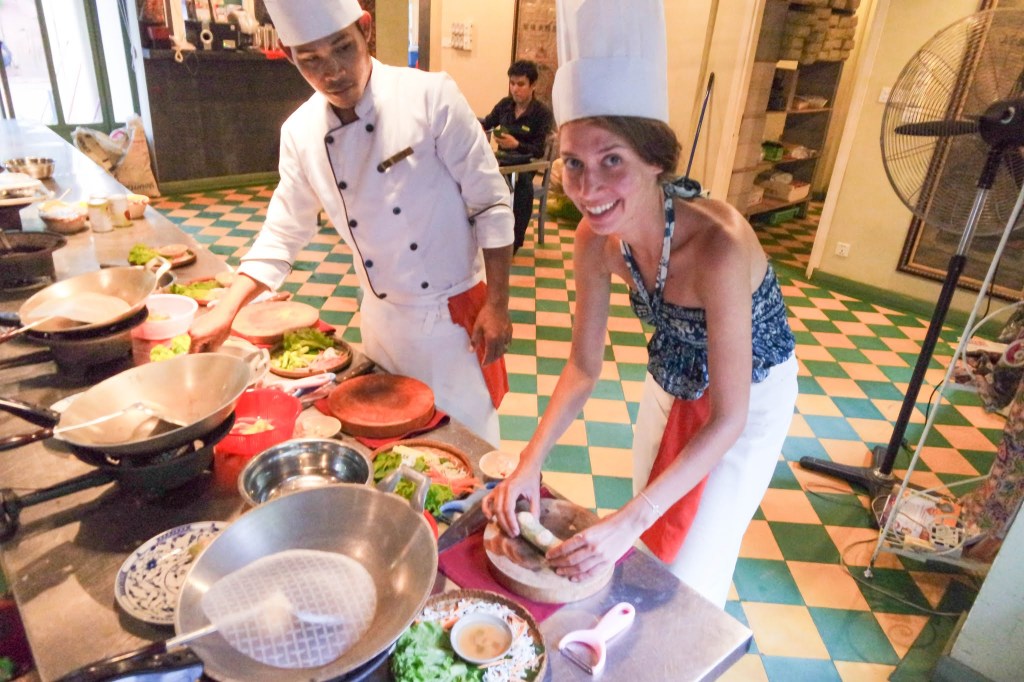
- cooking schools where you can learn to prepare traditional dishes.
Cooking Class – Discover the Flavors of Cambodia
One of the most interesting activities are culinary workshops. They usually begin with a visit to a local market, where you learn about:
- galangal, lemongrass, kaffir lime leaves,
- amok paste, shrimp paste, and fermented spices.
During the class you prepare, among others:
- Fresh spring rolls – with vegetables, herbs, and peanut sauce,
- Sweet fried bananas – in crispy coconut batter, served warm,
- Soups based on coconut milk and fresh herbs – aromatic, mildly spicy, with vegetables, lemongrass, and kaffir lime.
The Legacy of the Khmer Empire
Angkor is more than ruins. It is proof of an advanced civilization that:
- had a sophisticated irrigation system,
- created complex temple-cities,
- left behind some of the most impressive stone structures in the world.
Why Visit Siem Reap?
It is a place where you can at the same time:
- touch over 1,000 years of history,
- feel the jungle in the heart of stone ruins,
- discover the cuisine, culture, and everyday life of modern Cambodia.
Siem Reap is not just a base for Angkor – it is a meeting point of ancient empires and contemporary Asia that stays with you for a very long time.



 Malvina Dunder
Leave a comment