Chernobyl is not just an abandoned city or a tourist attraction. It is living proof of how thin the line is between technological progress and irreversible destruction of the Earth. In 1986, Reactor No. 4 suffered the worst nuclear disaster in history – during what was supposed to be a “safety test”.
Radiation knows no borders. An invisible cloud of radioactive dust rose into the atmosphere and, carried by the wind, travelled hundreds of kilometres – as far as Scandinavia, where sensors in Sweden were the first to alert the world. For many days the Soviet Union tried to conceal the true scale of the tragedy.
The city that was meant to be ideal
Pripyat was the pride of the USSR – the “City of Flowers”, with modern shops, a swimming pool, cinemas, cafés, universities and 35,000 roses planted across its squares. For its residents it was the fulfilment of the Soviet dream.
Everything ended within a few days.
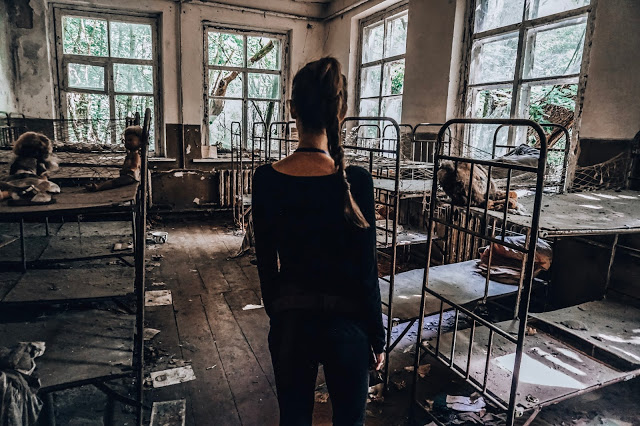
The evacuation took place only three days after the explosion. People left “just for a moment”. They abandoned clothes, toys, books – entire lives. They never returned.
What is radiation, really?
Radiation is everywhere – in the sun, in rocks, in our own bodies. But what was released in Chernobyl was ionising radiation, which damages DNA.
Three types:
- Alpha – does not penetrate the skin, but once inside the body it destroys cells from within.
- Beta – penetrates water and tissue; it can be stopped by a thin layer of metal.
- Gamma – like X-rays. It passes through the body and requires thick layers of concrete or lead to block it.
We don’t feel it. We don’t see it. But the cells are already dying.
Why Chernobyl is still a problem today
Radioactive atoms decay extremely slowly. Some will remain dangerous for 20,000 years. Contamination cannot be removed – it can only be covered and left to fade on its own.
In 1986 a person could work near the reactor for a maximum of one minute.
Today the annual limit is twelve minutes.
The sarcophagus – a bandage on the Earth’s wound
A concrete sarcophagus was built over the ruins of the reactor. It was known it would last only 20–30 years.
That is why the New Safe Confinement was constructed – a gigantic steel arch:
- cost: €2.1 billion
- 45 countries involved
- 5 million man-hours
- 2,200 workers from 21 countries
- larger than the Eiffel Tower and the Statue of Liberty combined
It is meant to protect the world for 100 years. What happens after that? No one knows.
The Zone – a paradise for animals?
When humans disappeared, nature returned. Today wolves, lynxes, Przewalski’s horses and even bears live in the zone. Trees grow through apartment blocks, streets turn into jungle.
But beneath the greenery, poison still pulses.
The Red Forest – where pine trees died within days – remains one of the most contaminated areas on Earth.
Can you go there?
Yes – legally only with a guide and a permit.
You must not:
- touch anything
- enter buildings
- eat outdoors
- leave the group
These are not rules. They are the boundaries between life and illness.
UPDATE: Since the outbreak of the war in Ukraine in 2022, the exclusion zone has been closed to tourists and it is currently impossible to visit it legally.
Why this is not “tourism”
This is not a curiosity.
It is a lesson in humility.
You see a city without people.
Children’s toys in a kindergarten.
A gynaecological chair rusting in a hospital.
Machines abandoned and forbidden to touch.
There is nothing you can do with them.
And you understand one thing:
We truly do not have a second Earth.
Chernobyl is not the past
It is not “an accident from years ago”.
It is a process that will last longer than any civilisation.
Chernobyl is not a story about the atom.
It is a story about responsibility.
And a warning we cannot ignore.
Let’s meet @malvinadunder


 Malvina Dunder
Leave a comment