
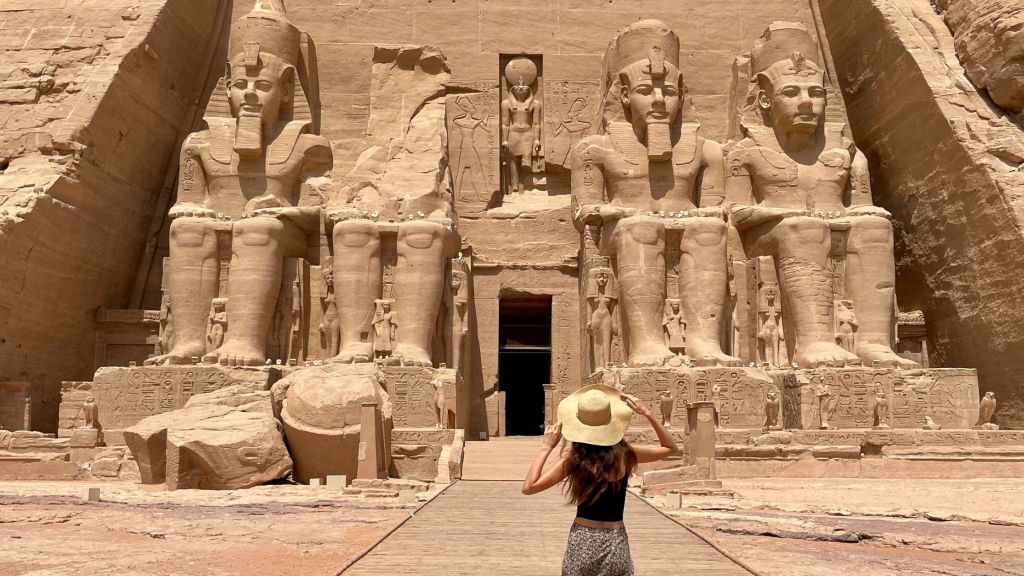
Egypt is one of those places in the world where history is not locked away in museums — it still lives in the landscape, the architecture and the rhythm of everyday life along the Nile. Monumental temples, deserts with surreal shapes and green islands rising out of the river create a mosaic that has fascinated travellers for millennia.
Below you will find the most characteristic places in Egypt — from Cairo to Abu Simbel — which best reveal the spiritual, historical and natural face of this country.
My journey began with what many people warn you about 😉 Flight delays and complications… and it wasn’t the first time! I had tried many times to come to Egypt to see the pyramids and temples, but something always got in the way — I even lost my tickets twice. Finally, it worked…
At Luxor airport we were greeted by our guide Youla Abdelnoor — I recommend checking her out on Facebook and booking with her. We started exploring Egypt on the West Bank of the Nile, where many tombs are located. The west symbolised sunset, the end, death and transformation, which is why pharaohs and queens were buried there. There is a lot to see here, but if you have limited time, you have to choose.
Valley of the Kings
The necropolis of New Kingdom pharaohs, where the most powerful rulers — including Tutankhamun — were buried in hidden tombs. The wall paintings are still astonishingly vibrant despite thousands of years.
I saw 4 tombs out of many. A standard ticket includes 3 entries, with the option to buy extra ones — some more expensive, some cheaper. Some tombs are periodically closed and reopened depending on their condition. At the entrance it is worth looking at the model showing how vast the site is and how deeply the tombs extend underground. I had time to visit: the Tomb of Merneptah, the Tomb of Ramesses III, the Tomb of Ramesses I, and the Tombs of Ramesses V and VI.
Temple of Hatshepsut
Nestled into the rocky amphitheatre of Deir el-Bahari, the temple of Queen Hatshepsut impresses with its harmony of form and landscape. It is one of the most elegant places in all of Egypt.
Hatshepsut is considered the only officially ruling queen of Egypt — a woman “pharaoh”. Cleopatra was Greek-Macedonian and ruled much later, in a completely different era. There may have been other ruling queens, but Egyptologists believe the evidence is clear only for Hatshepsut. This fascinating woman was controversial: she portrayed herself in a very masculine way, claimed divine origin, had many enemies, and one of them is said to have ended her life. Afterwards, her temples were devastated. She also commissioned the largest obelisk ever attempted, which unfortunately cracked — you can see it unfinished in Aswan.
📍Near the Temple of Hatshepsut there is a beautiful residential building of the Polish archaeological team, which has been restoring monuments in the area since the 1970s.
📍Nearby you can also see the house of Carter, famous for discovering — with the help of an Egyptian assistant — the tomb of Tutankhamun, never opened before and full of gold and treasures. The iconic golden mask of the pharaoh is in the Berlin museum.
Deir el-Medina – the Valley of the Artisans
Deir el-Medina is a unique settlement where the artists, architects and craftsmen who built and decorated the tombs in the Valley of the Kings lived. Unlike the monumental temples of the pharaohs, this place shows everyday life in ancient Egypt — homes, workshops, temples and private tombs full of colourful paintings. It is one of the best-preserved testimonies of how the creators of the greatest ancient masterpieces lived and worked.
Here you will find the ruins of the village and the tombs of overseers, which were illegal and hidden from the pharaoh. They are beautiful and still vividly colourful after so many millennia — dating back to around 1550 BC.
Medinet Habu
The Temple of Ramesses III is one of the best-preserved temple complexes in Egypt. The reliefs tell stories of wars, victories and royal rituals.
He was said not to like people much, isolating himself and carving his name deeply into the walls so that no one could erase it, as some pharaohs had done. Two statues of Sekhmet guard the entrance:
Hilton Luxor
A beautiful view of the Nile at sunset and hot-air balloons floating over the river at sunrise.
Karnak – the largest temple complex of antiquity
The Temple of Karnak is a monumental city of columns, pylons and sphinx avenues. Every pharaoh added his own part, creating over centuries the greatest religious complex of the ancient world.
The perfume palace – scents of ancient Egypt
In many Egyptian cities you can visit so-called “perfume palaces” — traditional shops where fragrances are created according to recipes inspired by ancient Egypt. The oils are thick, natural and extremely long-lasting, used not only as perfumes but also for skin care. Scents like lotus, jasmine, myrrh and frankincense were already known in pharaonic times, when perfumes were part of religious rituals and everyday life. Today Egypt and Morocco are among the world’s main suppliers of fragrance essences.
I bought lemon perfume in a magical bottle (I adore it) and lotus flower oil for a friend. Lotus and papyrus are symbolic plants in Egypt, carved in temples and shaped into columns. To me, papyrus smells more masculine, while blue lotus is more feminine.
Luxor Temple – the heart of ancient Thebes
Luxor Temple stands directly on the Nile and is one of the most impressive monuments of ancient Egypt. Unlike Karnak, it was not dedicated to gods but to the renewal of royal power. This is where the Opet processions took place, carrying statues of the gods along the avenue of sphinxes from Karnak to Luxor. Its monumental columns, pylons and statues of Ramesses II create an extraordinary atmosphere, especially after dark when the temple is illuminated.
Interestingly, the sphinxes here are proportionate — unlike the famous Sphinx in Giza.
Dendera – the Temple of Hathor
The Temple of Hathor in Dendera is famous for its perfectly preserved astronomical ceilings and reliefs depicting ancient knowledge of the stars. The famous round Dendera Zodiac, now an icon, is actually in the Louvre in Paris — the temple contains a replica.
I felt strongly drawn to this place, and when I arrived, I felt its magic. The temple was empty and I could enter secret chambers. One was high up — I had to climb a ladder and literally squeeze through a small opening. I also learned that this is already a Greco-Roman period temple, and its architecture differs from earlier ones.
Delicious Egyptian cuisine
Egyptian cuisine is based on simple, natural ingredients but delights with strong flavours. One of the most popular dishes is koshari — a filling mix of pasta, rice, lentils, chickpeas and spicy tomato sauce with onions. You will also commonly find falafel (in Egypt mainly made from fava beans) and freshly squeezed juices such as mango or sugar cane.
Fresh dates are also worth trying — different from those in Europe, they are soft, juicy and delicately honey-like. Egyptian food is available everywhere: in hotels, restaurants and street stalls, where you can experience it in its most authentic form.
Edfu – the Temple of Horus
About two hours by car from Luxor lies Edfu. The Temple of Horus is one of the best-preserved monuments of ancient Egypt. Dedicated to Horus, it retains nearly its entire structure — from monumental pylons to courtyards and the sanctuary. Reliefs depict the mythical battle between Horus and Seth, symbolising the victory of order over chaos.
Kom Ombo – the double temple on the Nile
An hour further lies Kom Ombo, uniquely designed as a perfectly symmetrical temple dedicated to two gods: Sobek, the crocodile god of the river, and Horus the Elder, the god of light and protection. Reliefs here also show some of the oldest known depictions of medical instruments.
Another hour from here brings you to Aswan.
Elephantine – the mysterious island
You can reach Elephantine Island by boat, for example to Basmatic Guest House. There are no paved roads here — dragging a wheeled suitcase might cost you its handle (as happened to me 🙂). The rooftop view is beautiful, the homemade food delicious and the owner very kind.
From here you can see temple ruins and the famous granite formations that intrigue many people because of their seemingly perfect lines, as if made with advanced technology. The island is tiny and known for its Nubian village with vividly coloured houses and a calm, African atmosphere. One house even had a large mummified crocodile in front of it!
The Unfinished Obelisk – Aswan quarry
In Aswan you can visit the famous Unfinished Obelisk — a massive granite block left in the quarry after cracking. Had it been completed, it would have weighed around 1,200 tons, making it the largest known obelisk of the ancient world.
This site offers a unique insight into ancient stone-working techniques, showing tool marks and grooves where dolerite balls were probably used to carve granite. Egyptologists propose various theories about how obelisks were extracted and erected — from wooden wedges soaked with water to rope systems and sand ramps — but many details remain debated.
Philae – the temple rescued from water
Philae is a small island on the Nile, now reached by boat from Aswan, with a temple dedicated to Isis, goddess of love, healing and rebirth. The temple you see today does not stand in its original place.
After the construction of the Aswan High Dam, the Nile rose and flooded the original island. In the 1970s UNESCO carried out a spectacular rescue: the temple was dismantled block by block, numbered and rebuilt on the nearby island of Agilkia. Today you can explore it almost exactly as it once was.
Old Cataract Hotel – a legend on the Nile
Sofitel Legend Old Cataract Aswan is a hotel with over a century of history, perched above the Nile by the First Cataract. It inspired Agatha Christie’s Death on the Nile. You can visit the historic library, enjoy a drink overlooking the river, admire sunsets, see archival photos, swim in the elegant pool, dine in the legendary 1902 restaurant and even stay in rooms once used by Christie or Winston Churchill.
Abu Simbel – monumental temples near the Sudanese border
About three hours south of Aswan lies Abu Simbel, near the Sudanese border. Two temples carved into solid rock await you: the Great Temple of Ramesses II and the smaller Temple of Nefertari, dedicated to his beloved wife.
In the 1960s they were threatened by flooding from Lake Nasser. Instead of losing them, they were cut into over 1,000 blocks and reassembled 65 metres higher — one of the greatest conservation projects in history.
Cairo – antiquity, empires and difficult heritage
Cairo is essential for understanding Egypt. The National Museum of Egyptian Civilization houses 22 royal mummies in a solemn, respectful gallery. There is also the Grand Egyptian Museum (GEM) and the old museum on Tahrir Square.
A fun story: Kim Kardashian once posted a selfie with a golden sarcophagus in New York — which helped Egyptian authorities trace and recover a stolen artefact!
Khan el-Khalili – the heart of Cairo’s trade
This centuries-old bazaar is a labyrinth of shops selling jewellery, crystals, lamps, incense and spices — a true feast for the senses.
Hotels with pyramid views & the Light Show
In Giza many hotels offer terraces overlooking the pyramids. In the evenings the Pyramids Sound & Light Showilluminates the monuments, telling stories of pharaohs and myths. I stayed at Panorama Pyramids Inn:
Pyramids of Giza and the Sphinx
Seeing the pyramids and entering them is unforgettable. The Sphinx remains mysterious — some believe it once depicted Anubis or a lion before being reshaped.
Dahshur – the Bent and Red Pyramids
Dahshur is quieter than Giza and home to the Bent Pyramid and the Red Pyramid, both from the reign of Sneferu. The Red Pyramid is considered the first true smooth-sided pyramid.
Saqqara – the cradle of pyramids
Saqqara holds the Step Pyramid of Djoser, the world’s oldest stone pyramid, and the Pyramid of Teti with the earliest known religious inscriptions — the Pyramid Texts.
The White Desert
In western Egypt stretches the White Desert, with chalk formations shaped by wind into surreal sculptures. I spent days here camping under the stars and even met a desert fox.
Let’s meet @malvinadunder


 Malvina Dunder
Leave a comment