
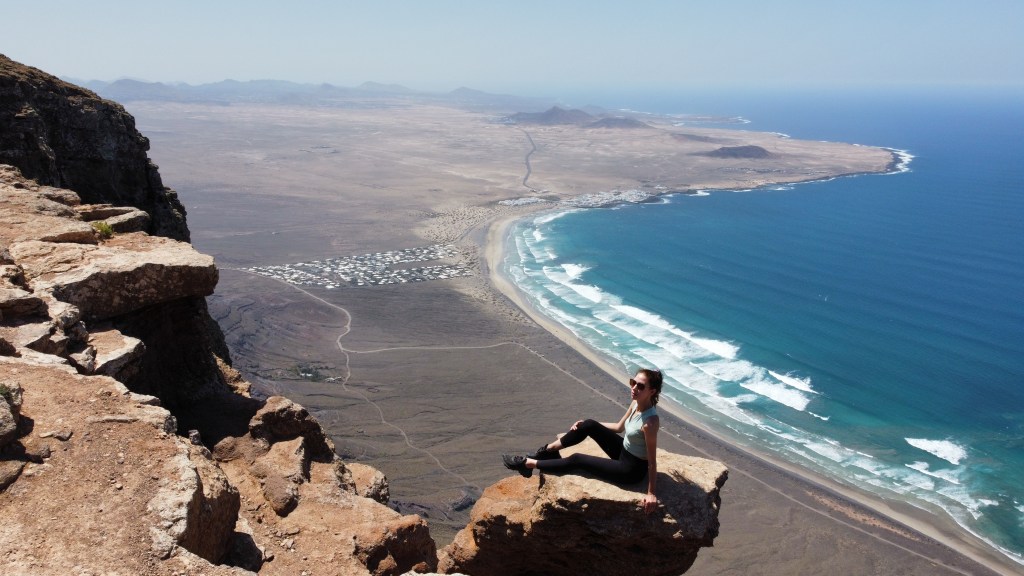
Lanzarote is one of the most extraordinary islands of the Canary archipelago. It is around 20 million years old and was shaped almost entirely by volcanic activity. The island contains four main calderas as well as dozens of cones and fissures, while basalts formed during the eruptions of 1730–1736 and 1824 cover nearly a quarter of its surface. It is in the area of Montañas del Fuego that the main eruption vents from the 18th century are located — a place that created one of the harshest landscapes in Europe.
Although Lanzarote attracts geology and photography lovers with its otherworldly scenery, the reality of the island turned out to be much more difficult for me than I had expected.
Timanfaya National Park – nature behind glass
Timanfaya National Park is undoubtedly the showcase of Lanzarote, but also the biggest surprise of this trip. The area is so heavily restricted that it feels more like a museum than a natural park. Sightseeing is possible only by bus — without stops and without the possibility to get out. The landscape is viewed through a window, often from a distance.
Here you can see a recording of the reality of Lanzarote — lots of prohibitions, closed roads and places accessible only from a bus:
Although this is explained by the need to protect a fragile ecosystem, it is hard not to feel that real contact with nature has been almost completely taken away. The park staff are very strict and the area is monitored by people and drones 24/7.
Wineries – the only truly open spaces
The most welcoming places on the island turned out to be the wineries. Here you can freely walk among lava fields, see the unique method of cultivating vines in pits protected by stone walls and taste volcanic Malvasía wine.
Tourist attractions – paid viewpoints
On Lanzarote many places advertised as “attractions” turn out to be cafés or restaurants with an entrance fee of 5–10 euros. One example is Mirador del Río — instead of going inside, you can stop at the car park and decide whether you really want to pay to enjoy the view of the neighbouring island.
The only place in this category that is a real attraction (not just a café or restaurant with a ticket) is the Cactus Garden:
Places that still impress
Las Grietas
Interesting rock formations resembling natural cracks in lava:
Mirador del Risco
A viewpoint with a breathtaking panorama — but it requires great caution:
Montaña del Cuervo
A crater you can walk into and see a volcano from the inside:
Green stones – olivine (peridot)
Natural volcanic minerals thrown out during eruptions:
El Golfo and Lago Verde – beauty from a distance
One of the most postcard-perfect spots on Lanzarote — a green lake contrasting with black sand. Unfortunately, access to the beach is closed and the view can only be admired from afar.
Caldera Blanca
A crater of an old volcano, accessible via a marked hiking trail:
Salinas de Janubio – sea salt fields
Papagayo Beach
César Manrique – the architect of Lanzarote’s soul
César Manrique (1919–1992) was an artist, architect and visionary who shaped the modern image of Lanzarote to a great extent. Thanks to him, the island is dominated by low white buildings with green and blue accents that blend harmoniously into the volcanic landscape. Manrique strongly opposed mass development and fought to preserve the island’s natural character, creating projects that combined art with nature — without destroying it. His former home, now a museum, shows how volcanic rocks can become part of architecture, and Lanzarote has retained its unique, recognisable style thanks to him.
In summary
Lanzarote is an island of unique landscapes and brilliant architecture, but also one of the most restrictive places I have ever visited. If you love nature, hiking and photography, other Canary Islands may be a better choice — Tenerife with Teide volcano, green La Palma or diverse Gran Canaria.
Lanzarote left me with a constant feeling of “prohibido” — instead of encouraging exploration of nature, it more often puts up barriers. It is an experience that is hard to forget.



 Malvina Dunder
Leave a comment