
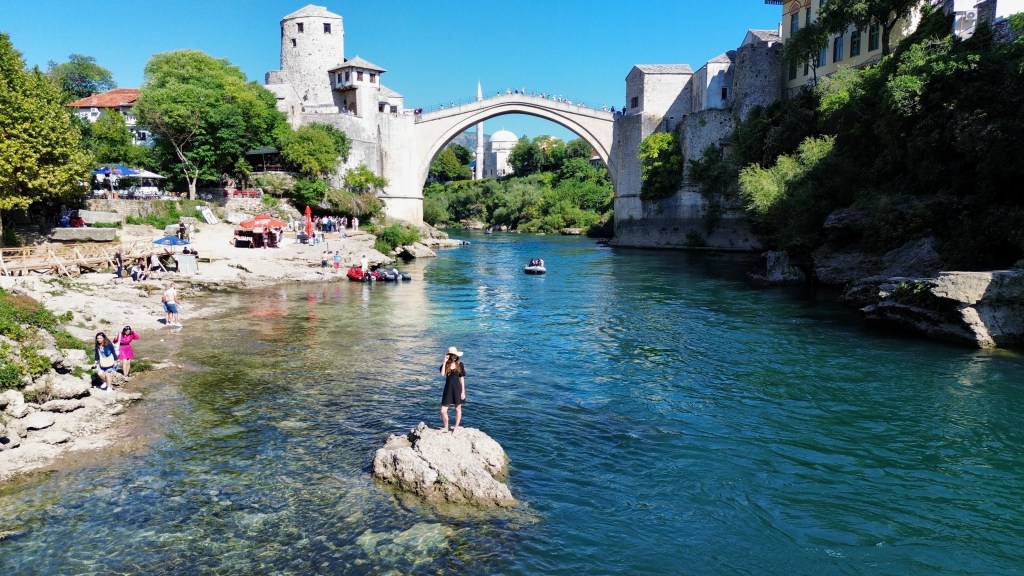
Bosnia and Herzegovina is a country of remarkable contrasts, where history, spirituality, and nature coexist within a very small area. Stone-built towns, Ottoman heritage, rivers of intense turquoise color, and lush green valleys create a landscape quite different from neighboring Balkan countries — calmer, more reflective, and rich in symbolism.
One of the most recognizable places is Mostar, with its iconic Old Bridge, a symbol of both the city and the entire region. Nearby are the impressive Kravice Waterfalls, surrounded by dense greenery, as well as Blagaj Tekke — a dervish monastery located at the source of the Buna River, in a place with a truly unique atmosphere. Another important point on the map of the country is Medjugorje, known as one of the most recognized pilgrimage destinations in Europe.
Below you’ll find the most well-known and characteristic places in Bosnia and Herzegovina — cities, landmarks, and landscapes that reveal the spiritual and cultural character of this country.
My trip to Bosnia and Herzegovina was quite short but very enjoyable, and if you are also considering visiting these places, I invite you to watch short videos and photos that give a small glimpse of what it’s like and whether it’s worth going.
Mostar
When I woke up in Mostar in the morning (after traveling from Croatia) and walked through the streets of the old town, I felt as if I were in Turkey rather than Europe — a result of centuries of Ottoman influence. A fascinating cultural mix and architecture:
The main focal point of Mostar is the river and the beautiful Old Bridge. It is very high, and people jump from it into the river — but this is only for the brave and for those who already know how to do it. If you’re interested in such a challenge, you can look for local “professionals” who, for a fee, will teach you how to jump and allow you to practice from a lower platform near the river.
If extreme experiences are not your thing, you can opt for a calm boat ride along the river or simply wander through the old streets.
It’s also worth trying local sweets and traditional dishes — they are delicious. Along the way, in small towns, you can stop at bakeries offering authentic, freshly baked goods with an incredible aroma.
Kravice Waterfalls
This place is relatively small but absolutely beautiful, and you can swim there. The entrance fee is also much lower (around €15) compared to nearby Croatia (around €50). You can easily spend a whole day here — eat at the bars, rent a sun lounger or even a private floating platform on the lake, take a guided boat ride, or jump straight into the water.
A small but extraordinary corner of the Earth.
Blagaj Tekke Monastery
Blagaj is located at the source of the Buna River and is home to the historic Tekke (also known as the Tekija or Dervish Monastery). Blagaj Tekke was built around 1520 and combines elements of Ottoman architecture with Mediterranean influences. It was constructed as a monastery for dervishes.
A dervish is a member of a Sufi (mystical) brotherhood, comparable to the Arabic term faqir. Dervishes lived in communal houses or led a wandering life, characterized by poverty and complete devotion to God. They are known for their distinctive clothing and spinning dance, during which the fabric of their garments flows outward. This dance represents a form of spiritual connection with God — a state of unity and transcendence — symbolizing the rotation of celestial bodies.
Medjugorje
I came across Medjugorje completely by accident. I hadn’t planned to visit and felt no particular need to go there — I only knew the place from stories told by older, very religious people and had long forgotten about it. It wasn’t until the name appeared on road signs and in the GPS that I decided to stop by. In the town center, what immediately stands out is the sheer number of images of the Virgin Mary — I don’t think I’ve ever seen so many in one place. I had a pizza, looked around, and… that could have been the end of it.
Out of curiosity, however, I began to explore the history of the place. I learned that in the 1980s, several children reportedly experienced apparitions of the Virgin Mary on a nearby hill, and these events were promoted by a local priest. Over time, Medjugorje became one of the most well-known pilgrimage sites in Europe — to this day, believers from all over the world come here, and those who experienced the apparitions in childhood continue to share their experiences as adults.
It’s hard not to find this phenomenon impressive — a small, otherwise unremarkable village became globally known, though without these events, it would likely have remained unknown. Regardless of personal beliefs, if Medjugorje serves as a place of spiritual connection for so many people, giving them a sense of meaning, strength, peace, and hope, that in itself carries a very positive value.
Let’s meet @malvinadunder


 Malvina Dunder
Leave a comment