
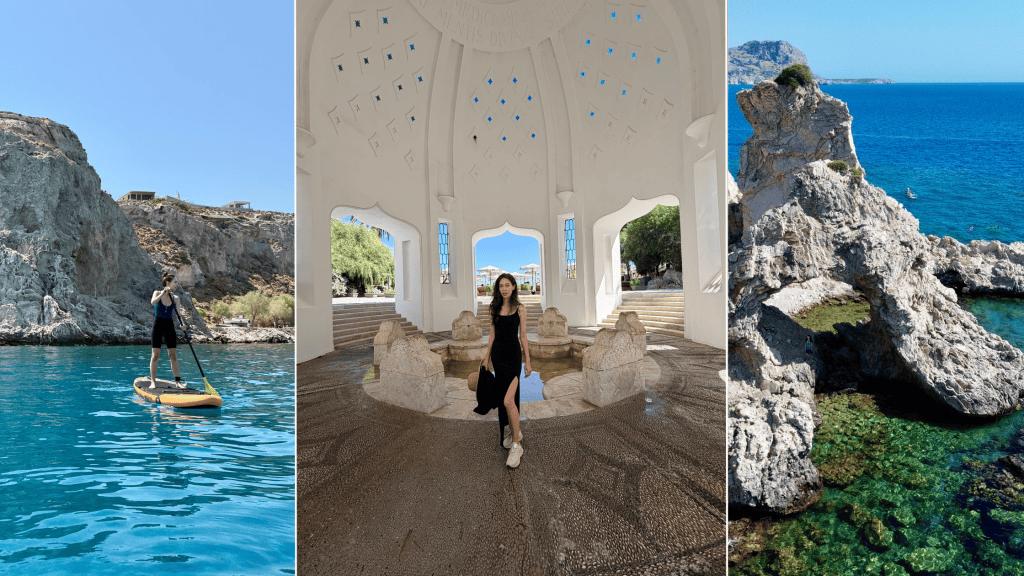
Rhodes is one of the most diverse islands in the Dodecanese. It combines ancient archaeological sites, medieval architecture, turquoise bays, sandy beaches, green valleys and classic Mediterranean landscapes. With a history stretching back thousands of years, the island has been shaped by many different cultures and civilizations.
Rhodes is a destination where you can explore an ancient temple in the morning, spend the afternoon swimming in crystal-clear water and finish the day looking at planets through a telescope. Here are some of the most interesting places and experiences to include in a trip to Rhodes.
1. Lindos and the Acropolis of Lindos
One of the most famous places on Rhodes is Lindos, a picturesque town on the island’s east coast. Its whitewashed houses, narrow streets and colorful bougainvillea make it one of the most recognizable places on the island.
Above the town stands the Acropolis of Lindos, dramatically positioned on a rocky hill overlooking the Aegean Sea. It is one of the most important archaeological sites on Rhodes. The most famous monument is the Temple of Athena Lindia, but the site also contains remains of a Hellenistic stoa, monumental entrance structures, a Byzantine church and buildings dating from the period of the Knights of St John.
The walk up to the Acropolis is part of the experience. From the top, there are spectacular views over the white houses of Lindos, the coastline and the deep blue sea.
It is worth allowing several hours for Lindos, as there is plenty to explore beyond the archaeological site, including the village itself and the nearby beaches.
2. Tsambika Beach and the Viewpoint
Tsambika Beach is one of the most beautiful and popular beaches on Rhodes. The long sandy beach is surrounded by hills and offers clear, turquoise water.
Above the beach is Tsambika Monastery, located on a hill overlooking the coast. Reaching the monastery requires climbing a long staircase, but the panoramic view from the top is one of the most impressive on this part of the island.
Tsambika is therefore a good destination for combining a beach day with a short hike and a spectacular viewpoint.
3. Kallithea Springs
Kallithea Springs is one of the most interesting places on Rhodes for anyone who enjoys a combination of history, architecture and nature.
The springs were known in antiquity for their mineral waters. The elegant complex that can be seen today was developed during the Italian period and officially opened in 1929. After years of deterioration, it was restored and reopened to visitors in 2007.
The complex is surrounded by Mediterranean vegetation and built around a beautiful coastal cove. Visitors can explore the historic buildings, mosaics and gardens before heading down to the sea.
Kallithea is also a popular place for swimming and snorkeling.
4. Butterfly Valley
Butterfly Valley, or Petaloudes, is one of the most unusual natural attractions on Rhodes.
The valley is a lush, shaded area filled with trees, streams, small waterfalls and wooden walking paths. During the summer months, enormous numbers of Jersey tiger moths (Euplagia quadripunctaria) gather here.
Despite its name, Butterfly Valley is actually famous for moths rather than butterflies. When resting, the insects keep their wings closed and can be surprisingly difficult to spot. When disturbed, however, they open their wings and the valley can suddenly appear to fill with flashes of orange and black.
The walking route through the valley continues uphill towards the Monastery of Panagia Kalopetra.
The best time to visit is during the summer period when the moths are present in large numbers.
5. Stegna Beach and the Rocky Coast
Stegna Beach, near the village of Archangelos, is a beautiful coastal destination with a more relaxed atmosphere.
In addition to the beach itself, the surrounding rocky coastline is worth exploring. Rock formations create small coves and interesting areas for swimming and snorkeling.
The combination of clear water, rocky landscapes and traditional coastal scenery makes Stegna a good choice for travelers who want something different from the island’s larger resort beaches.
6. Snorkeling in the Clear Waters
The clear waters surrounding Rhodes make the island an excellent destination for snorkeling.
Many of the island’s beaches have rocky sections, underwater formations and sheltered coves where visitors can observe fish and marine life.
Kallithea and several locations along the east coast are particularly popular for swimming, snorkeling and diving.
A mask and snorkel are useful to have, especially when exploring smaller beaches and less developed parts of the coastline.
7. Stand-Up Paddleboarding
Rhodes also offers plenty of opportunities for water sports, including stand-up paddleboarding (SUP).
Paddling along the coast provides a different perspective of the island and allows visitors to explore the shoreline from the water. Sheltered bays are particularly suitable for beginners.
SUP is also a surprisingly good balance challenge – even calm-looking Mediterranean water can make staying upright on the board more interesting than expected.
8. Hidden Beaches and Small Coves
One of the pleasures of exploring Rhodes is discovering the smaller beaches and secluded coves away from the main tourist areas.
Some can be reached by road, while others require a short walk or hike. These less-developed beaches can offer a quieter experience and an opportunity to enjoy the coastline without the facilities and crowds found at the larger resorts.
Before visiting a remote beach, it is worth checking the access route and sea conditions, as some locations can be rocky or difficult to reach.
9. Rhodes Observatory
One of the more unusual attractions on the island is the Rhodes Observatory, located in the area of Prophet Amos near Faliraki.
The observatory offers visitors the opportunity to learn about astronomy and observe celestial objects through telescopes.
For anyone interested in astronomy, this can be a particularly memorable experience. After spending the day exploring the island, the evening offers an entirely different kind of landscape – the night sky above Rhodes.
It is also a refreshing alternative to the more traditional historical and beach attractions.
10. The Medieval Old Town of Rhodes
No trip to Rhodes is complete without exploring the Old Town of Rhodes.
The medieval city is a UNESCO World Heritage Site and is one of the best-preserved medieval urban complexes in the Mediterranean.
The Old Town is surrounded by impressive defensive walls and filled with narrow streets, historic buildings and hidden courtyards.
Some of the highlights include Street of the Knights, the Palace of the Grand Master, the medieval city walls and numerous buildings connected with the Knights of St John.
Walking through the Old Town feels very different from visiting the island’s beaches and modern resorts and offers an opportunity to experience one of the most important chapters in Rhodes’ history.
11. The Acropolis of Rhodes
Lindos is not the only place on the island with an ancient Acropolis.
The Acropolis of Rhodes is located on Monte Smith, in the western part of Rhodes Town. The archaeological site contains remains of the ancient city, including temples, a stadium and a theatre.
The site is particularly interesting for visitors interested in ancient Greek history and archaeology. It also provides views across the city and surrounding coastline.
12. Prasonisi – Where Two Seas Meet
At the southern tip of Rhodes lies Prasonisi, a distinctive peninsula connected to the island by a sandy strip.
The area is famous for its unusual landscape and for the contrasting sea conditions on either side of the peninsula. This makes Prasonisi particularly popular with windsurfers and kitesurfers.
The shape of the sandy connection can change depending on the season and water levels, making the landscape different at different times of year.
Even for visitors who do not participate in water sports, Prasonisi is an interesting place to visit because of its dramatic coastal scenery.
13. Greek Food – What to Try in Rhodes
Exploring Rhodes also means discovering Greek cuisine. Vegetarian travelers will find plenty of options, from traditional meze to hearty vegetable-based dishes.
Some dishes worth trying include:
- Gigantes – large butter beans baked in tomato sauce and herbs
- Dolmades – vine leaves stuffed with rice and herbs
- Horiatiki – traditional Greek salad with tomatoes, cucumber, olives and feta
- Gemista – tomatoes or peppers stuffed with rice and herbs
- Fava – a creamy purée made from yellow split peas
- Melitzanosalata – a dip made from roasted eggplant
- Spanakopita – filo pastry filled with spinach and feta
- Kolokithokeftedes – Greek zucchini fritters
- Grilled vegetables and Greek cheeses
Greek cuisine is particularly well suited to sharing, so ordering several small dishes or meze is a great way to try different flavors during a meal.
14. Medusa and Greek Mythology
Greek mythology is an important part of the cultural landscape of Rhodes, and one of the most recognizable mythological figures is Medusa.
Medusa was one of the three Gorgons and is traditionally depicted as a woman with snakes instead of hair. According to the most famous version of the myth, her gaze could turn anyone who looked directly at her into stone.
Medusa was eventually defeated by the hero Perseus, who used the reflection in his shield to avoid looking directly at her.
Her image became an important symbol in ancient Greek art. The Gorgoneion, or head of Medusa, was often used as a protective symbol believed to ward off evil and danger.
The image of Medusa can still be found throughout Greece today, from archaeological motifs to contemporary art and souvenirs.
Rhodes – An Island Where History Meets Nature
Rhodes is much more than a beach destination. Its greatest strength is the variety of experiences it offers within a relatively compact island.
Lindos and its Acropolis provide a glimpse into the ancient history of the island, while the Medieval Old Town of Rhodes reveals its later European and Byzantine influences. Kallithea Springs combines architecture and nature, while Butterfly Valley offers a completely different side of the island.
For those who prefer the sea, places such as Tsambika, Stegna, Prasonisi and the island’s many smaller coves provide opportunities for swimming, snorkeling, paddleboarding and simply enjoying the Mediterranean landscape.
And after a day spent exploring ancient ruins, beaches and mountain paths, there is always another way to discover Rhodes: by looking up at the night sky.
With its combination of history, mythology, nature, beaches, food and outdoor activities, Rhodes is an island that can appeal to very different kinds of travelers – and is especially rewarding for those who want to combine relaxation with exploration.
Let’s meet @malvinadunder


Leave a Reply